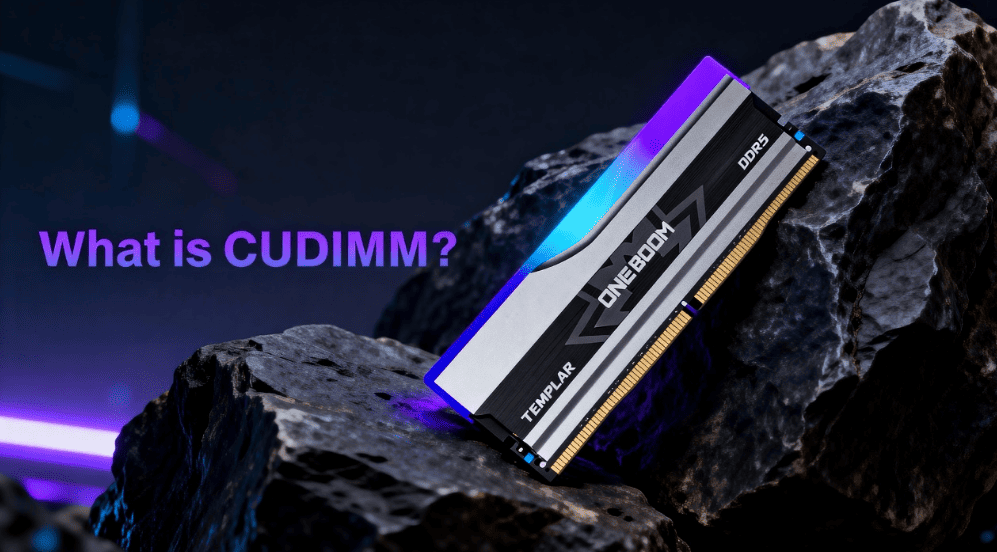
DDR5 memory has moved far beyond its original starting point of 4800 MT/s. In just a short time, mainstream platforms have progressed toward 6400 MT/s, 7200 MT/s, and even higher speeds. As frequencies rise, however, performance is no longer limited only by memory chips themselves.
At this stage, signal integrity becomes the key challenge. Many users notice that although high-frequency memory is officially rated at very high speeds, systems may struggle to boot, fail stability tests, or become unreliable during long-term operation. In other words, “running at high speed” and “running stably at high speed” are not the same thing.
This shift makes one conclusion clear: when DDR5 frequency continues to increase, the memory architecture itself must evolve.

What Are CUDIMM and CSODIMM?
With that background in mind, CUDIMM and CSODIMM were introduced as part of the DDR5 standard to solve these high-frequency challenges.
CUDIMM (Clocked UDIMM) is designed for desktop platforms, while CSODIMM (Clocked SO-DIMM) targets laptops, Mini PCs, and other compact systems. Although they serve different form factors, their core design concept is the same.
The key difference can be summarized in one sentence:
CUDIMM and CSODIMM integrate a dedicated Clock Driver (CKD) directly on the memory module.
What Does the Clock Driver (CKD) Actually Do?
To better understand why this matters, it is important to look at the role of the CKD.
In traditional DDR5 memory, clock signals are generated by the memory controller and distributed directly across the module. At high frequencies, these signals can suffer from attenuation, jitter, and timing inconsistency.
By contrast, the CKD on CUDIMM and CSODIMM performs several critical functions:
Buffers and reshapes the clock signal
Reduces jitter and signal degradation at high speed
Improves timing consistency across memory chips
Makes high-frequency operation more controllable
It is important to note that CKD is not designed to increase benchmark scores, but rather to ensure stable and reliable operation at high frequencies.
Why Traditional UDIMM and SODIMM Struggle at High Frequencies
As frequencies rise, the limitations of traditional memory designs become more visible.
Heavy Dependence on the Motherboard
First, traditional DDR5 memory relies entirely on the motherboard for clock delivery. This places enormous pressure on PCB layout quality, trace length, layer count, and interference control. Even small design differences can affect stability.
High Frequency Amplifies Signal Problems
Second, issues such as jitter, crosstalk, and timing mismatch may be minor at lower speeds but are amplified significantly at higher frequencies. What was once acceptable becomes a system-level risk.
Short-Term Operation vs Long-Term Stability
Finally, while some systems may boot successfully at high speeds, maintaining that performance under continuous workloads is much more difficult. This difference is especially noticeable in AI computing, content creation, and other sustained-load scenarios.
Core Architectural Differences: Traditional Memory vs CUDIMM / CSODIMM
To clearly illustrate the difference, the table below compares the two architectures at a structural level:
| Comparison Item | Traditional UDIMM / SODIMM | CUDIMM / CSODIMM |
|---|
| Clock Management | Clock fully driven by motherboard | Dedicated CKD on memory module |
| High-Frequency Stability | Decreases significantly as frequency rises | More controlled at high frequencies |
| Motherboard Dependency | Very high | Significantly reduced |
| Long-Term Load Behavior | Stability risk increases | Better suited for sustained workloads |
This comparison highlights why architectural changes are necessary as DDR5 enters higher speed ranges.
Why CUDIMM Is Especially Suitable for AI PCs and New High-Performance Platforms
As workloads evolve, memory requirements change accordingly.
AI Workloads Are Continuous, Not Bursty
AI tasks such as local model inference and parallel data access place continuous pressure on system memory. Unlike short benchmark runs, these workloads require memory to perform consistently over time.
Stability and Timing Consistency Matter More Than Peak Speed
In AI and professional computing, small fluctuations in memory latency can affect user experience and processing efficiency. As a result, predictable performance is often more valuable than extreme peak frequency.
Compact Systems Depend More on Signal Quality
Mini PCs, ITX systems, and laptops have limited PCB space, making signal integrity more difficult to manage. For these platforms, CSODIMM provides clear architectural advantages by improving clock control directly on the module.
Should Consumers Prioritize CUDIMM / CSODIMM Right Now?
With all the advantages CUDIMM and CSODIMM bring to high-frequency DDR5 platforms, a natural question follows: Should consumers choose these new memory types first when upgrading? The answer is more nuanced than a simple yes or no.
CUDIMM / CSODIMM Will Not Replace UDIMM/SODIMM DDR5 Overnight
In the short to medium term, traditional DDR5 UDIMM and SODIMM will continue to dominate the mainstream consumer market. Standard DDR5 already delivers excellent performance on today’s mature platforms, and for most users, mid-range DDR5 frequencies provide stable and predictable gains.
Cost Efficiency Still Matters in Today’s Market
Memory prices remain relatively high compared to previous cycles, and CUDIMM / CSODIMM introduce additional components and validation requirements that further increase cost. From a cost-performance perspective, UDIMM/SODIMM DDR5 remains the more economical choice for most users today.
CUDIMM/CSODIMM Is Not a “Drop-In” Upgrade
One critical point often overlooked is that CUDIMM does not deliver its full benefits in isolation.
Its advantages rely on a complete platform ecosystem, including:
A new-generation CPU with an updated memory controller
A motherboard designed to support CKD
BIOS and firmware optimized for clocked memory modules
Upgrading only the memory while keeping an older CPU or motherboard will not unlock the intended performance improvements.
Practical DDR5 Buying Advice for Today’s Consumers
As DDR5 becomes the mainstream memory standard, the most important question for consumers is no longer “What is the fastest?” but rather “What is appropriate for my platform and workload?”
KingSpec UDIMM DDR5 RGB and DDR5 Heatsink Memory — Performance with Visual Identity and Sustained Workloads
The KingSpec DDR5 RGB Series is designed for users who want a balance of performance, stability, and system aesthetics.
Key characteristics include:
Speed up to 8000MT/s, Max 32GB.
Stable DDR5 performance tuned for mainstream desktop platforms
Integrated RGB lighting that complements modern gaming and showcase builds
Optimized power and signal design to ensure consistent performance during gaming and multitasking
The KingSpec DDR5 Heatsink targets users who prioritize long-term stability and thermal efficiency.
Its design focuses on:
Speed up to 8000MT/s, Max 32GB.
A dedicated heatsink structure to improve heat dissipation
Improved thermal consistency under sustained memory loads
Enhanced stability for extended multitasking, creation, and productivity scenarios
This type of DDR5 memory is well suited for:
Gaming PCs/ Content creators
High-performance home systems
Users who value both system appearance and everyday responsiveness
Rather than focusing on extreme overclocking scenarios, the design goal is reliable DDR5 performance that integrates seamlessly into modern desktop builds.
Conclusion: Choosing Memory for Today — While Understanding What Comes Next
In conclusion, DDR5 memory is moving away from pure frequency competition and toward architectural evolution. CUDIMM and CSODIMM are designed for real workloads, sustained operation, and modern computing demands. When frequency is no longer the only metric, architecture becomes the true foundation of memory performance.
However, technical progress does not always translate into immediate upgrade necessity. For most current platforms, well-designed DDR5 UDIMM solutions continue to offer the best balance of performance, stability, and value. Understanding emerging standards like CUDIMM is useful for future planning, but memory upgrades should always match real workloads and platform readiness.